Best Fans for Warehouses That Actually Work
A warehouse that feels 10 to 15 degrees hotter at the rack level than it does near the office is not just uncomfortable. It is a sign that air movement, heat stratification, and ventilation design are out of balance. Choosing the best fans for warehouses starts with that reality. The right fan is not the one with the biggest diameter or the lowest price. It is the one matched to your ceiling height, floor plan, heat load, process conditions, and ventilation objective.
That distinction matters because warehouses rarely have just one problem. Some buildings need destratification in winter and employee cooling in summer. Others need high-volume air circulation over loading zones, packing areas, or battery charging stations. In hotter facilities, the fan selection may need to work alongside roof exhaust, make-up air, or evaporative cooling. When a buyer skips that step and treats all warehouse fans as interchangeable, the result is usually dead air, excess power draw, and poor comfort where people actually work.
What makes the best fans for warehouses?
The best warehouse fan is defined by application first, then by specification. If your priority is moving a large column of air slowly and efficiently across open floor space, an HVLS fan is usually the lead candidate. If you need directional airflow in one work zone, a barrel fan, pedestal fan, or wall-mounted circulation fan may make more sense. If the building is heat-loaded and stagnant, circulation fans alone may not fix the problem without coordinated exhaust and intake air.
This is why CFM by itself does not tell the whole story. A fan may have impressive airflow on paper but still perform poorly if the throw pattern is wrong, static pressure is ignored, or obstructions block circulation. Racking, dock doors, partition walls, process equipment, and ceiling-mounted lights all affect what happens after the fan turns on.
For most warehouse projects, the real decision comes down to five variables: ceiling height, square footage, occupancy, internal heat gain, and whether the building needs circulation, destratification, exhaust, or a combination of all three.
Best fans for warehouses by application
HVLS fans for large open warehouse floors
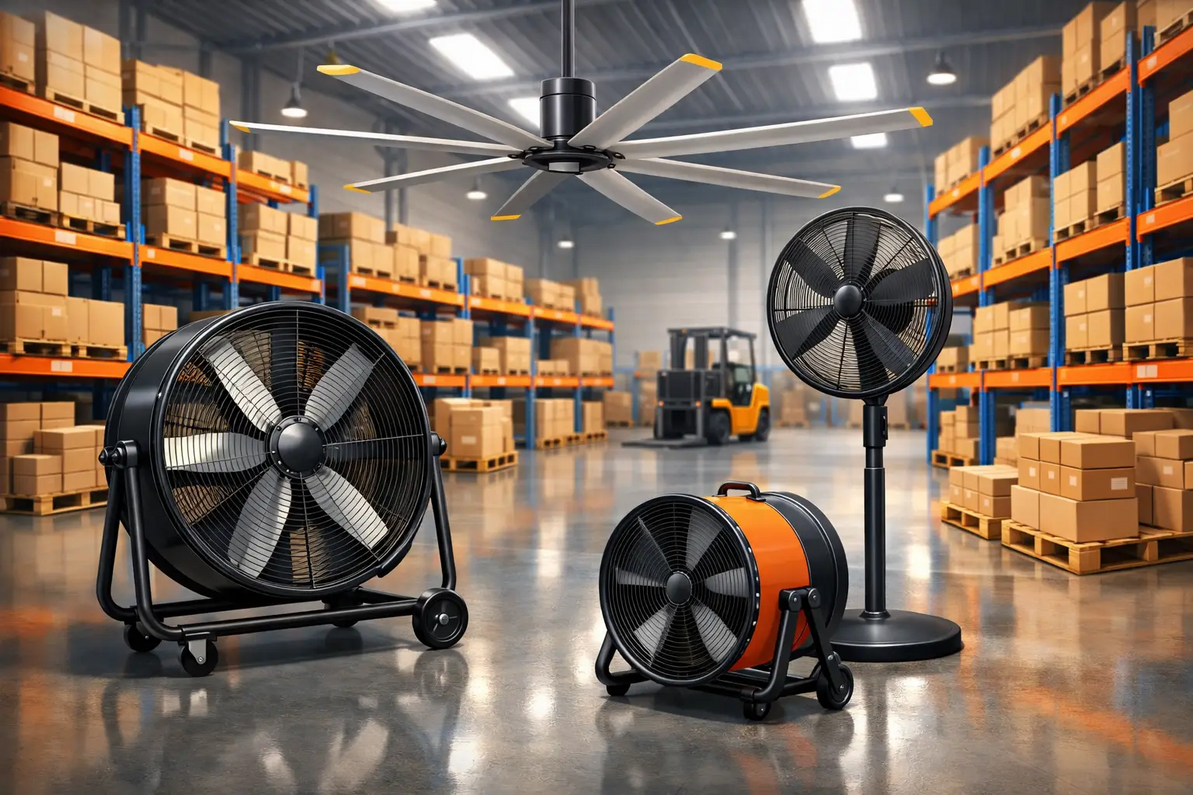
HVLS stands for high-volume, low-speed. These are often the best fans for warehouses with high ceilings and broad open areas because they move a very large air mass at low RPM. That gives you floor-level air movement without the harsh draft you get from smaller high-speed units.
In a conventional storage or distribution building, HVLS fans are often the most energy-efficient way to cover a large footprint. They can reduce heat stratification in winter by pushing trapped ceiling heat back toward occupied zones. In summer, they improve evaporative cooling on skin, which helps workers feel cooler even when thermostat settings stay higher.
That said, HVLS fans are not automatic fits. They need proper spacing, adequate mounting height, and clearance from sprinklers, lights, and structural members. In tightly packed rack systems, the air pattern can be interrupted, which may require multiple smaller units or a hybrid approach with directional circulation fans.
Wall-mounted and directional fans for targeted airflow
When the issue is localized hot spots, the best answer is often a targeted fan rather than a giant ceiling fan. Packing lines, shipping stations, mezzanines, maintenance bays, and loading docks often benefit from wall-mounted or pedestal-mounted circulation fans that drive air exactly where workers need it.
These fans are useful in facilities with lower ceilings or heavy obstructions where HVLS coverage is compromised. They also help in seasonal problem areas, such as dock doors that trap heat in summer or corners with weak natural circulation. The trade-off is coverage. You may solve one zone well, but not the whole building.
Barrel fans and floor fans for portable spot cooling
Portable barrel fans are common in warehouses because they are flexible and easy to reposition. They are effective during temporary production shifts, maintenance shutdowns, or workstations that move. For short-term cooling or supplemental air movement, they are practical tools.
But they are not usually the most efficient long-term answer for whole-building comfort. They can be noisy, create uneven airflow, and clutter aisles if overused. In many buildings, portable fans end up compensating for an undersized or poorly designed ventilation system.
Exhaust fans when heat and contaminants must leave the building
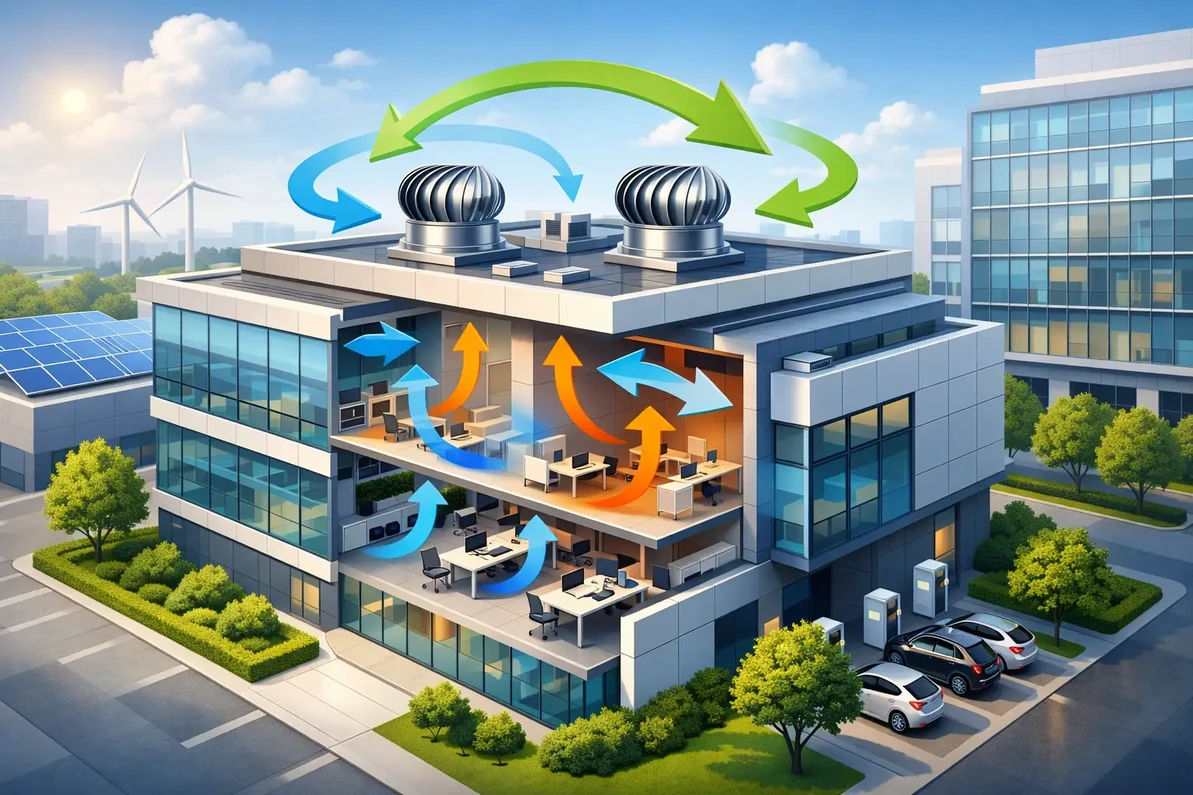
Some warehouses do not just need air movement. They need air exchange. If forklifts, charging stations, packaging equipment, washdown operations, or process heat are raising indoor temperatures, circulation fans alone may only move hot air around.
In those cases, roof-mounted or wall-mounted exhaust fans paired with make-up air can be the better solution. This becomes even more important in facilities dealing with fumes, humidity, or combustion byproducts. The best system often combines exhaust, intake, and circulation so the building gets both fresh air and usable air velocity in occupied areas.
How to choose the right fan size and layout
The sizing conversation should begin with building dimensions, but it should not end there. Square footage and ceiling height provide a starting point for fan diameter and quantity, especially with HVLS applications. However, a warehouse with 30-foot clear height and open floor storage behaves very differently than one with the same footprint filled with high-density pallet racking.
Airflow design should account for aisle orientation, rack height, dock activity, and internal heat sources. If the goal is destratification, fan placement should encourage vertical air mixing without blasting workers below. If the goal is floor-level cooling, blade diameter, RPM, and coverage pattern matter more than headline CFM alone.
Motor type also deserves attention. Direct-drive systems are often preferred for lower maintenance, while variable speed control is almost always worth considering in commercial and industrial facilities. The ability to reduce speed seasonally or by occupancy can improve comfort, lower energy use, and help fine-tune performance after installation.
Noise can also be a deciding factor. Warehouses with packing operations, offices, or customer-facing areas may need quieter operation than heavy industrial spaces. A fan that looks strong on paper can become a problem if it adds excessive sound in occupied zones.
Common mistakes when buying warehouse fans
One of the most common mistakes is buying based on fan diameter alone. Bigger is not always better if the fan is mounted too low, blocked by structure, or mismatched to the application. Another frequent issue is treating circulation and ventilation as the same thing. They are not. Circulation improves air movement inside the building. Ventilation removes heat, humidity, or contaminants and replaces indoor air with outdoor air.
A second mistake is underestimating the role of building pressure. If you install powerful exhaust without enough make-up air, performance drops and doors become harder to open. If you add large circulation fans without solving the actual heat source, the building may still feel uncomfortable. Good fan selection depends on understanding the full airflow path.
Finally, many buyers ignore control strategy. Warehouses are dynamic spaces. Shift changes, seasonal temperatures, door openings, and production loads all change the airflow requirement. Fans with variable frequency drives or integrated speed controls usually provide better long-term value than single-speed equipment.
When one fan type is not enough
The best warehouse ventilation plans are often mixed systems. An HVLS fan may handle general circulation across the main storage floor, while wall fans support dock zones and exhaust fans pull out concentrated heat near the roofline. That combination is common in buildings where comfort, product protection, and energy efficiency all matter.
This is where engineering guidance pays off. Fan selection should not happen in isolation from the rest of the building. Roof type, intake openings, insulation level, process heat, and utility costs all affect what equipment will perform well. A cheaper fan that misses the application can cost far more over time in wasted energy and poor results.
For facility managers, engineers, and contractors, the right question is not simply, what are the best fans for warehouses? The better question is, what airflow strategy will solve the actual problem in this building? Once that is clear, the product category usually becomes much easier to identify.
Factory Fans Direct works with commercial and industrial buyers who need that level of support, especially where CFM, static pressure, motor selection, and building layout cannot be guessed at from a product photo. If you are evaluating warehouse fans, start with the operating conditions and airflow goal, not just the catalog page.
A well-chosen warehouse fan should do more than move air. It should improve worker comfort, reduce stratified heat, support ventilation performance, and fit the building like it was specified for it from day one.
Factory Fans Direct - Commercial & Industrial Ventilation & Cooling Experts | Contact Mike Miller VP Engineering at Factory Fans Direct for a FREE Project Evaluation 888-849-1233 | Mike@FactoryFansDirect.com
Recent Posts
-

Smart Buildings Architects Recommend Edmonds ecoPOWER Hybrid Ventilation
A rooftop ventilator should not force an all-or-nothing energy decision. Smart Buildings Architects …7th Sep 2026 -
Smart Industrial Buildings Use Edmonds ecoPOWER Hybrid Ventilation
A roof exhaust system can be the difference between a plant that controls heat at the source and one …7th Sep 2026 -
Smart Commercial Buildings Use Edmonds Hybrid Ventilation
A rooftop exhaust fan that only performs when the wind blows is not a complete ventilation strategy. …7th Sep 2026