Hydro-Cooling for Crypto Mining Containers
Air-cooled mining containers hit a wall fast. Once ambient temperatures rise, dust loads increase, or miner density gets pushed beyond conservative design limits, fan-only cooling starts costing uptime, hash rate stability, and equipment life. That is where Hydro-Cooling for Crypto Mining Containers becomes a serious engineering option, not a marketing trend.
For containerized mining, the core problem is simple: ASICs produce concentrated heat in a small footprint, and standard ventilation has limits. You can move a lot of CFM through a container, but every design still has to deal with intake temperature, exhaust recirculation, static pressure, filtration loss, and the power draw of the cooling system itself. Hydro-cooling changes that equation by using water-based heat rejection to control inlet conditions more precisely.
Why hydro-cooling makes sense in container mining
The main advantage is thermal control under high heat load. In many mining deployments, air cooling works well enough during mild weather, then struggles during summer peaks or in hotter regions. Hydro-cooling can reduce intake air temperatures and stabilize operating conditions across more hours of the year. That means fewer thermal throttling events, better miner consistency, and more predictable output.
It also helps when operators want higher rack density inside a container. The more machines you install, the less margin you have for hot spots, uneven airflow, and fan performance losses across filters or coils. A properly engineered hydro-cooled container can support tighter layouts because heat removal is less dependent on outside air conditions alone.
Noise and contamination are part of the equation too. Open-air systems pull in dust, pollen, and airborne debris that eventually coat heat sinks and electronics. Hydro-cooling setups can reduce the volume of raw outside air needed or improve how incoming air is treated. That lowers maintenance frequency and can improve long-term reliability in agricultural, desert, or industrial areas.
How Hydro-Cooling for Crypto Mining Containers works
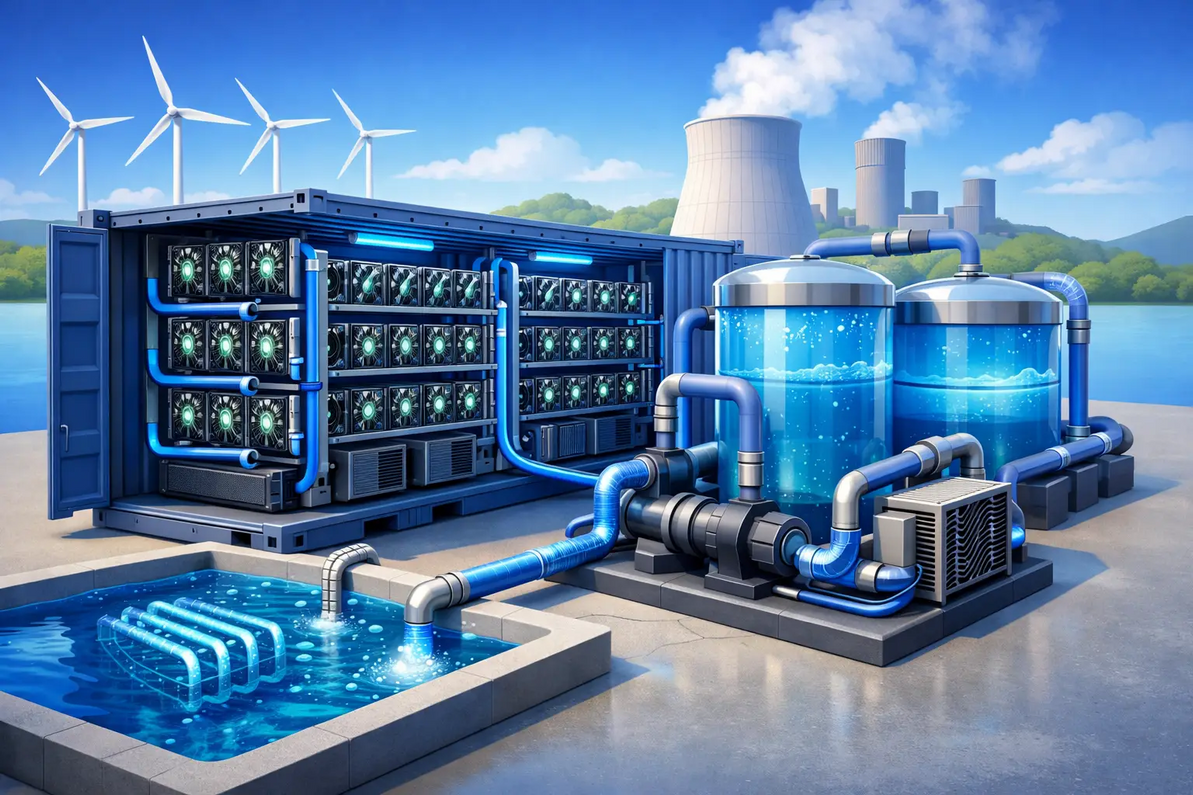
In most container applications, hydro-cooling does not mean the electronics are directly exposed to water. More commonly, it refers to water-assisted cooling systems that lower air temperature through heat exchangers, evaporative media, or closed-loop thermal transfer equipment before the air reaches the miners, or as part of a broader immersion support system.
The right design depends on site conditions. In dry climates, evaporative approaches can be highly effective and energy efficient. In humid regions, their performance drops, so closed-loop fluid coolers or hybrid systems may make more sense. Water quality, freeze risk, scaling potential, maintenance staffing, and utility availability all matter. A design that performs well in West Texas may not be the right answer for coastal Florida.
This is where many container projects go off track. Buyers focus on miner count but not total heat rejection, entering water temperature, approach temperature, pump requirements, or airside pressure losses. If those values are not matched correctly, the result is usually uneven cooling, wasted energy, and service headaches.
The engineering details that matter most
For a mining container, cooling should be sized from actual heat load, not guesswork. Every ASIC contributes to the total BTU burden, and the system has to reject that heat under worst-case operating conditions. That means looking at full electrical draw, not idealized spec-sheet numbers.
After heat load, airflow path is the next priority. Even with hydro-cooling, container performance still depends on how air moves through the miners, across coils or pads, and out of the enclosure. Poor plenum design, undersized exhaust, or bad intake placement can create recirculation and dead zones that erase the benefit of the cooling equipment.
Controls are just as important. Variable frequency drives, staged pumps, temperature sensors, and automated fan response can keep the container inside target conditions without running every component at full speed all day. That reduces parasitic energy use and gives operators better visibility into system performance.
Water-side design deserves equal attention. Flow rate, pump head, fluid quality, drain-down strategy, and service access all affect reliability. If the system is hard to clean, hard to winterize, or vulnerable to scale buildup, operating costs rise quickly. In crypto mining, simple systems usually win because they are easier to maintain under continuous duty.
When hydro-cooling is the better choice
Hydro-cooling is usually worth a close look when the site has high ambient temperatures, high miner density, strict noise targets, or contamination issues that punish open-air cooling. It is also a strong fit when operators need better thermal stability to protect uptime and avoid heat-related derating.
That said, it is not always the lowest-cost path. Water-based systems introduce more components, more design variables, and more maintenance requirements than basic exhaust ventilation. If the container is in a mild, dry climate with moderate density, a well-designed ventilation package may still be the most practical option.
The decision comes down to total operating performance, not just first cost. A cheaper cooling system that causes throttling, repeated shutdowns, or shortened miner life is rarely the cheaper system over time.
Factory Fans Direct works with container mining and data center operators that need ventilation and cooling matched to real heat loads, site conditions, and performance targets. If you are evaluating Hydro-Cooling for Crypto Mining Containers, get the heat rejection, airflow, and controls reviewed before equipment is ordered. That is usually where the expensive mistakes can still be avoided.
Factory Fans Direct - Crypto Mining & Data Center Cooling Experts Contact Mike Miller VP Engineering at Factory Fans Direct for a FREE Project Evaluation 888-849-1233 | Mike@FactoryFansDirect.com
Recent Posts
-

Smart Buildings Architects Recommend Edmonds ecoPOWER Hybrid Ventilation
A rooftop ventilator should not force an all-or-nothing energy decision. Smart Buildings Architects …7th Sep 2026 -
Smart Industrial Buildings Use Edmonds ecoPOWER Hybrid Ventilation
A roof exhaust system can be the difference between a plant that controls heat at the source and one …7th Sep 2026 -
Smart Commercial Buildings Use Edmonds Hybrid Ventilation
A rooftop exhaust fan that only performs when the wind blows is not a complete ventilation strategy. …7th Sep 2026