
AI Energy Saving ecoPOWER Hybrid Turbine Ventilation for Industry
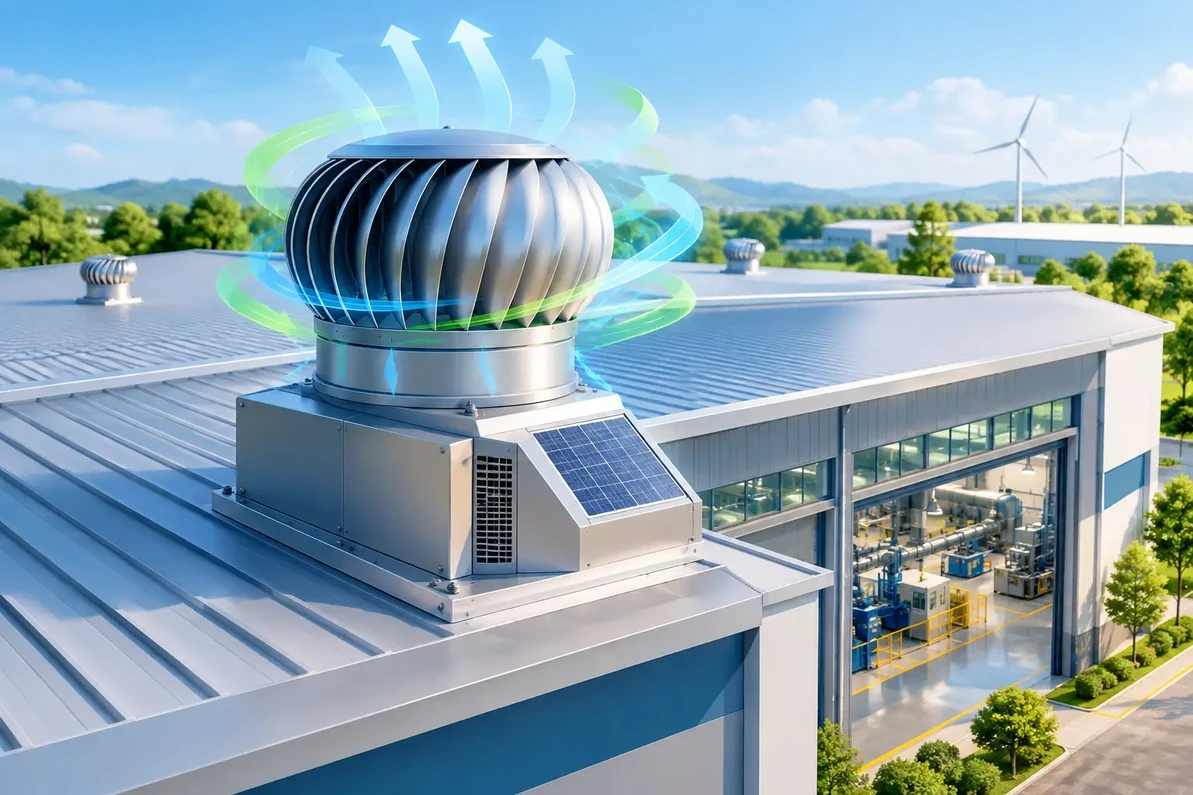
A roof exhaust system should not force a facility to choose between dependable airflow and lower electrical consumption. AI Energy Saving Commercial & Industrial ecoPOWER Hybrid Turbine Ventilation addresses that operating problem with a true hybrid approach: wind-assisted natural ventilation when conditions allow, plus a high-performance EC brushless DC motor when powered exhaust is required. The result is controlled, continuous roof ventilation without treating every hour of operation like a full-load fan hour.
For warehouses, manufacturing plants, agricultural buildings, cultivation operations, and heat-intensive equipment rooms, the value is not simply a lower wattage number. It is the ability to maintain a planned air path as outdoor wind conditions, internal heat gain, and occupancy change throughout the day.
Why conventional rooftop exhaust can waste energy
A standard powered roof fan is easy to understand. It runs at a fixed speed or follows a basic thermostat, drawing electrical power whenever the motor operates. That may be appropriate where a fixed exhaust volume is critical, but it can be inefficient when the building already has usable wind energy at the roofline.
A passive turbine ventilator takes the opposite approach. It can move air without electrical input when wind is available, but performance is tied to weather conditions. During still, hot periods - often when a facility needs heat relief most - a passive unit cannot deliver predictable mechanical exhaust.
The ecoPOWER design is built around the gap between those two choices. Its turbine can operate from wind energy, while its EC motor provides controlled powered operation when natural draft and wind-driven rotation are not sufficient. This is not a solar-powered ventilator. It is a hybrid rooftop exhaust ventilator combining non-powered wind operation with electrically driven ventilation.
That distinction matters during design review. Solar equipment depends on panel exposure, battery strategy when applicable, and solar production that may not align with the building's heat load. A hybrid turbine uses the available wind resource directly and adds efficient motorized operation for continuity.
How ecoPOWER Hybrid Turbine Ventilation works
The system combines a roof-mounted turbine assembly with an electronically commutated, brushless DC motor. EC motor technology is a practical advantage in commercial ventilation because it can deliver efficient operation, controllability, and lower maintenance exposure than many conventional motor arrangements.
When wind is available, the turbine supports airflow with little or no electrical energy for the ventilation function. When wind falls away or the facility's control strategy calls for active extraction, the motor takes over to maintain exhaust performance. Instead of relying on a single operating mode, the ventilator uses the condition that is most useful at that moment.
The actual savings depend on location, roof exposure, operating hours, building leakage, intake-air design, and the required exhaust rate. A tall building in an open, windy industrial area will not behave like a sheltered warehouse surrounded by higher structures. Likewise, a facility with inadequate make-up air may see poor ventilation results regardless of how efficient the roof exhaust fan is.
Controls make the hybrid concept useful
The mechanical equipment is only part of the decision. Facilities increasingly want ventilation tied to temperature, humidity, pressure, occupancy, equipment status, and utility demand. An AI cooling interface can analyze those operating inputs and recommend or automate ventilation stages rather than leaving rooftop equipment permanently on a manual setting.
For example, a warehouse may use temperature trend data to initiate powered exhaust before heat accumulates in the upper zone. A production building can coordinate roof exhaust with make-up air equipment to avoid excessive negative pressure. In specialized cooling environments, controls can flag when measured temperatures are not responding to commanded airflow, signaling a potential intake restriction, fan issue, or heat-load change.
AI does not replace ventilation engineering. It improves how the system responds after the CFM requirement, static pressure assumptions, intake area, and equipment arrangement have been properly established. Good controls cannot correct a fan that is undersized for the heat load or a building that cannot admit enough replacement air.
Where hybrid rooftop exhaust makes sense
Commercial and industrial ecoPOWER hybrid turbine ventilation is particularly relevant where facilities require regular heat relief but do not need maximum mechanical exhaust every minute of every day. Warehouses with high ceilings, manufacturing floors with intermittent process heat, sports and assembly buildings, agricultural structures, and naturally ventilated production areas are common candidates.
It can also be effective in facilities pursuing LEED or Net-Zero operational objectives. The point is not to claim that a single roof ventilator makes a building Net-Zero. Rather, reducing fan energy where wind can provide useful ventilation supports the broader energy strategy alongside insulation, lighting, process controls, heating and cooling equipment, and envelope improvements.
For cultivation and greenhouse applications, the evaluation must be more specific. Plants require managed temperature, humidity, and vapor-pressure conditions, and uncontrolled outside air can affect pest, odor, filtration, and dehumidification strategy. Hybrid exhaust may fit portions of the operation, but it should be selected as part of a complete environmental-control plan.
High-heat crypto mining and data center environments also require caution. These sites often need tightly managed, high-volume airflow with defined equipment inlet temperatures and redundancy requirements. A hybrid turbine may have a role in auxiliary spaces or appropriate exhaust zones, but critical equipment cooling should be designed around confirmed heat rejection, pressure drop, filtration, containment, and failure-mode requirements. Do not substitute a general ventilation concept for a calculated cooling design.
Design questions before selecting a unit
The right selection starts with operating data, not roof opening size alone. A useful project evaluation considers the required CFM, indoor and outdoor design temperatures, sensible heat load, roof geometry, prevailing wind exposure, mounting location, available make-up air, and whether the building needs pressure control.
Static pressure deserves special attention. Louvers, bird screens, dampers, filters, duct transitions, and restrictive intake paths all add resistance. A fan may be rated for an attractive free-air airflow number, yet deliver substantially less once installed in the actual system. The same applies to a turbine: roof placement, obstructions, and airflow path affect field performance.
Noise, weather protection, roof curb compatibility, electrical service, controls integration, and maintenance access should also be resolved before purchase. The lowest first-cost option is not necessarily the lowest operating-cost option, especially when a poor selection leads to heat complaints, production disruption, or a second installation to correct inadequate airflow.
A practical operating strategy
The strongest installations use hybrid rooftop ventilation as part of an air-management system. Provide adequate low-level or sidewall intake air, establish a clear path for heat to rise and exit, and avoid short-circuiting exhaust air directly back into nearby intake openings. In larger buildings, zoned equipment is often more useful than one oversized exhaust point because heat loads and occupancy are rarely uniform.
Control sequences should match the facility's actual priorities. A straightforward approach may start with wind-assisted ventilation, enable EC motor operation at a temperature setpoint, and increase powered exhaust as temperatures rise. More advanced strategies can incorporate variable speed, pressure sensing, weather data, occupancy schedules, and AI-based trend analysis.
Commissioning is where the design becomes real. Verify fan rotation and control response, confirm motorized dampers and make-up air equipment operate together, measure representative temperatures, and check for doors that become difficult to open from excessive negative pressure. Commissioning data gives operations teams a usable baseline for future troubleshooting.
Get an engineered evaluation before buying
ecoPOWER hybrid ventilation is a strong fit when a building can benefit from both wind-driven airflow and controlled powered exhaust. It is not a universal replacement for every conventional roof fan, and it should not be selected from a catalog without confirming the airflow objective and roof conditions. The best outcome comes from matching the ventilator, controls, make-up air path, and operating schedule to the building's real heat and pressure demands.
Factory Fans Direct/Edmonds US provides commercial and industrial ventilation design guidance, factory-direct pricing, and a free project evaluation for facilities that need a defensible equipment recommendation. Contact Mike Miller, VP Engineering, at 888-849-1233 or Mike@FactoryFansDirect.com to review your roof exhaust, cooling, and AI control requirements before equipment is specified.
Factory Fans Direct/Edmonds US provides commercial and industrial ventilation evaluation for projects involving roof exhaust, hybrid ventilation, make-up air, warehouse heat relief, manufacturing airflow, and energy-focused controls. Bring the building dimensions, heat sources, roof plan, and operating schedule to the conversation - those details turn a rooftop ventilator selection into a ventilation system that can be measured and managed.
Factory Fans Direct/Edmonds US - Hybrid Commercial & Industrial Ventilation & Cooling Experts | Contact Mike Miller VP Engineering at Factory Fans Direct for a FREE Project Evaluation 888-849-1233 | Mike@FactoryFansDirect.com
Recent Posts
-

AI Energy Saving ecoPOWER Hybrid Turbine Ventilation for Industry
A roof exhaust system should not force a facility to choose between dependable airflow and lower ele …16th Nov 2026 -
Volume Discounts on Industrial Ventilation
A ventilation quote should not start with a fan model number. It should start with the operating pro …15th Nov 2026 -
Warehouse Ventilation Volume Discounts
A warehouse that feels hot, dusty, or stagnant rarely has a simple “add more fans” problem. Volume D …15th Nov 2026